 How-to
Is Roof Spray Safe for the Environment? 7 Facts to Know
Last Updated: November 12, 2026
Quick Summary
Roof spray safety depends on the product type, its ingredients, and how it is applied. Cleaning sprays with biocides carry higher runoff risk than rejuvenation sprays, so checking the safety data sheet and containing runoff matter most.
- Cleaning sprays with biocides carry higher runoff risk than rejuvenation sprays.
- Request the safety data sheet and full ingredient list before buying any roof spray.
- Check each ingredient's aquatic toxicity and biodegradability on the safety data sheet.
- Avoid spraying before rain, since rain increases chemical runoff into drains.
- Disconnect downspouts from storm drains and rain barrels before applying any treatment.
Table of Contents
- What Roof Spray Is and Why Environmental Safety Varies
- Roof Cleaning Sprays vs. Roof Rejuvenation Sprays
- Roof Rejuvenation Spray Ingredients, Assessed One by One
- How Bleach-Based and Plant-Based Options Compare
- Eco-Friendly Roof Moss Killer: What Actually Works Without Heavy Runoff
- Protecting Pets, Plants and Your Household During Application
- Environmental Impact of Roof Runoff and How to Contain It
- Choosing a Safe Treatment for Your Austin Roof
- Frequently Asked Questions
What Roof Spray Is and Why Environmental Safety Varies
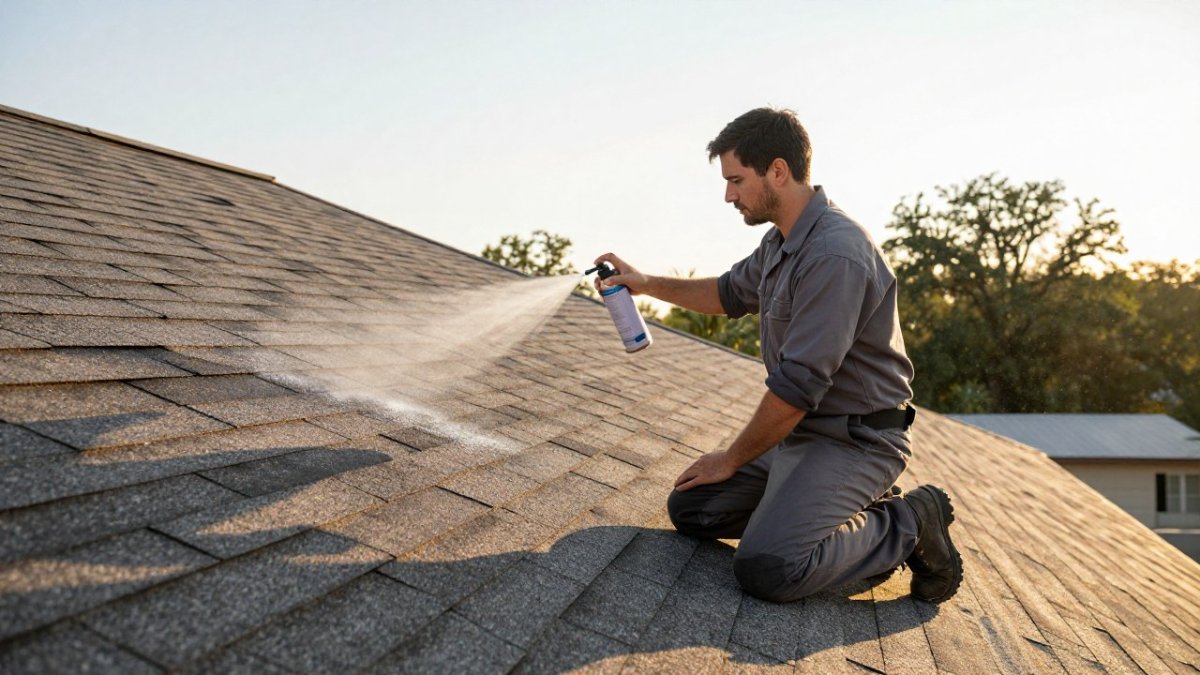
Roof spray is a liquid applied to asphalt shingles to clean, treat, or restore them. Whether it is safe for the environment depends on what is in the bottle and how it is used. Products with harsh chemicals can run off into gutters, yards, and storm drains. The label still matters.
The right answer depends on the product type, the ingredients, and how carefully the work is done.
Roof Cleaning Sprays vs. Roof Rejuvenation Sprays
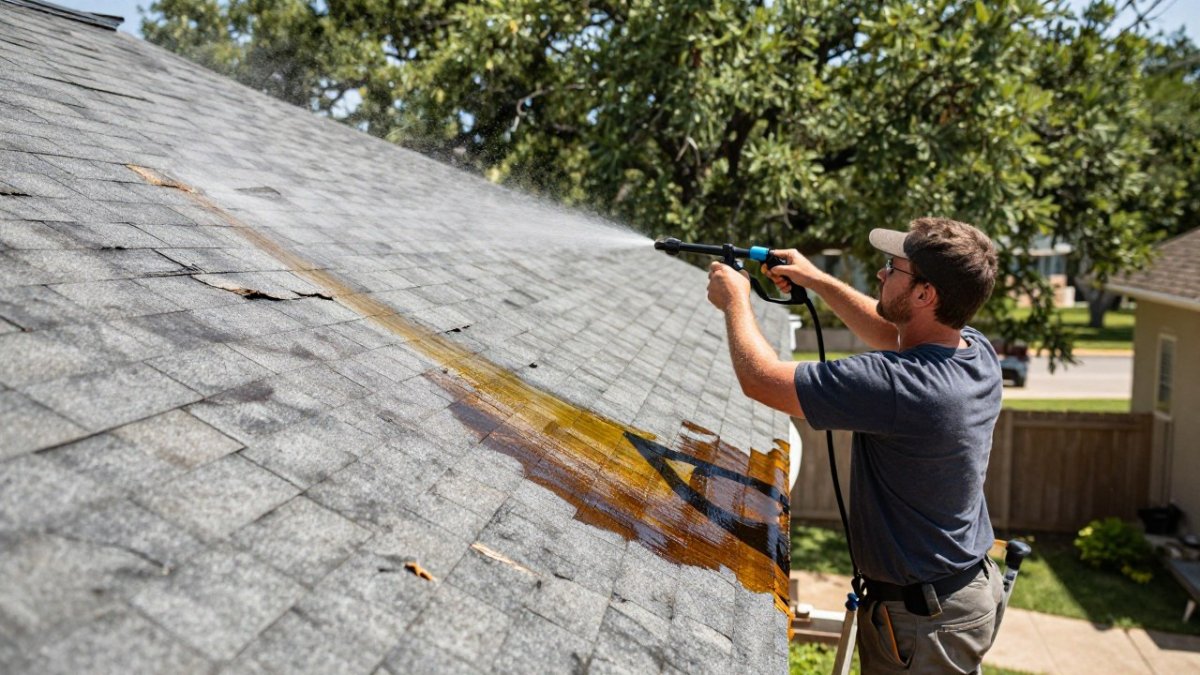
These two product types are often confused, but they do different jobs. A roof cleaning spray removes moss, algae, dirt, and stains from the surface. A roof rejuvenation spray is designed to restore flexibility to aging shingles by adding oils back into the asphalt.
Cleaning sprays usually rely on stronger biocides, which is why their runoff risk is higher. Knowing which one you are buying tells you which safety questions to ask.
- Cleaning sprays: remove growth, often use biocides, higher runoff concern
- Rejuvenation sprays: restore shingle oils, typically lower chemical load
- Both: require protection for plants, pets, and people during application
Roof Rejuvenation Spray Ingredients, Assessed One by One
Most roof spray safety claims collapse under scrutiny because they treat 'the product' as a single thing. In reality, a roof rejuvenation spray is a carrier solvent plus one or more active oils, surfactants, and sometimes biocides or UV stabilizers.
The most useful first step is to request the product's Safety Data Sheet (SDS) and full ingredient disclosure. Manufacturers of chemical products generally provide a safety data sheet (SDS) that lists hazardous ingredients, but 'hazardous' is a regulatory threshold, not a complete environmental toxicity picture. A product can be SDS-compliant and still contain ingredients with high aquatic toxicity.
Here is how to assess the common ingredient classes you will encounter:
- Petroleum-derived solvents (e.g., mineral spirits, naphtha, kerosene fractions): These are effective carriers for penetrating shingle oils, but they are volatile organic compounds (VOCs) that contribute to ground-level ozone. They are also toxic to aquatic life at low concentrations. A rejuvenation spray that relies heavily on petroleum solvents will have a higher VOC profile and a greater runoff concern than a water-based or plant-oil-based formula.
- Plant-derived oils (e.g., linseed oil, soybean oil, tung oil, citrus terpenes): These are generally more biodegradable than petroleum solvents, but 'plant-based' is not synonymous with 'safe.' Linseed oil can spontaneously heat and ignite on rags, and some plant oils are still toxic to fish and invertebrates. Check the SDS for aquatic toxicity language (H400-series hazard statements) rather than assuming biodegradability equals low toxicity.
- Surfactants and emulsifiers: These help the oil mix with water or spread evenly. Some surfactants (particularly nonylphenol ethoxylates) are persistent and estrogenic in aquatic environments; others break down readily. The SDS should identify the surfactant class.
- Biocides (e.g., quaternary ammonium compounds, sodium hypochlorite, zinc or copper salts): These are more common in cleaning sprays than rejuvenation sprays, but some 'restorative' products include a biocide to prevent regrowth. Quaternary ammonium compounds (quats) are persistent in sediment and toxic to aquatic organisms. Zinc and copper are effective moss killers but accumulate in soil and can harm plants and aquatic life.
- UV stabilizers and pigments: Often added to extend the life of the coating. Some are persistent, bioaccumulative, and toxic (PBT) substances. Ask whether the product contains any PBT-listed ingredients.
For each ingredient, look for three data points on the SDS: (1) the aquatic toxicity endpoint (LC50 or EC50 for fish, daphnia, or algae, lower values mean higher toxicity), (2) the biodegradation rate (readily biodegradable vs. inherently biodegradable vs. persistent), and (3) the bioaccumulation potential (log Kow or BCF). A product with readily biodegradable ingredients and low aquatic toxicity is a better environmental choice than one with persistent or bioaccumulative ingredients, even if both are labeled 'eco-friendly.'
Watch out: A manufacturer that will not provide an SDS or ingredient list is a red flag.
Warranty terms also matter here. Review the coverage and exclusions in our Roof Rejuvenation Warranty and Guarantee Coverage Explained before you pay for treatment.
The article breaks down the common ingredient classes in roof rejuvenation sprays and what each means for environmental safety.
| Ingredient class | Example | Environmental concern |
|---|---|---|
| Petroleum-derived solvents | Mineral spirits, naphtha, kerosene fractions | VOCs add to ground-level ozone; toxic to aquatic life |
| Plant-derived oils | Linseed, soybean, tung, citrus terpenes | Generally more biodegradable, but can still be toxic to fish |
| Surfactants and emulsifiers | Nonylphenol ethoxylates | Some are persistent and estrogenic in water |
| Biocides | Quats, sodium hypochlorite, zinc or copper salts | Quats persist in sediment; zinc and copper accumulate in soil |
| UV stabilizers and pigments | Various | Some are persistent, bioaccumulative, toxic (PBT) substances |
How Bleach-Based and Plant-Based Options Compare
Bleach-based products are effective at killing organisms, but chlorine bleach is harmful to aquatic life and can damage plants and landscaping it touches. When it runs off a roof, it can reach storm drains and nearby waterways. It also releases strong fumes during application.
A plant-based label does not mean a product is harmless if it is poured in excess. Dilution and coverage rates still matter.
Eco-Friendly Roof Moss Killer: What Actually Works Without Heavy Runoff
Many homeowners search for an eco-friendly roof moss killer. Mild, plant-based products applied in a controlled way are one option to ask about. Zinc and copper-based treatments can be effective, but they can wash off in rain and accumulate in soil. Look for products that state their runoff profile clearly.
Moss tends to return when shade, moisture, and debris stay on the roof. Removing debris and trimming overhanging branches can reduce how often you need any treatment at all. That is often the most environmentally sound step.
Protecting Pets, Plants and Your Household During Application
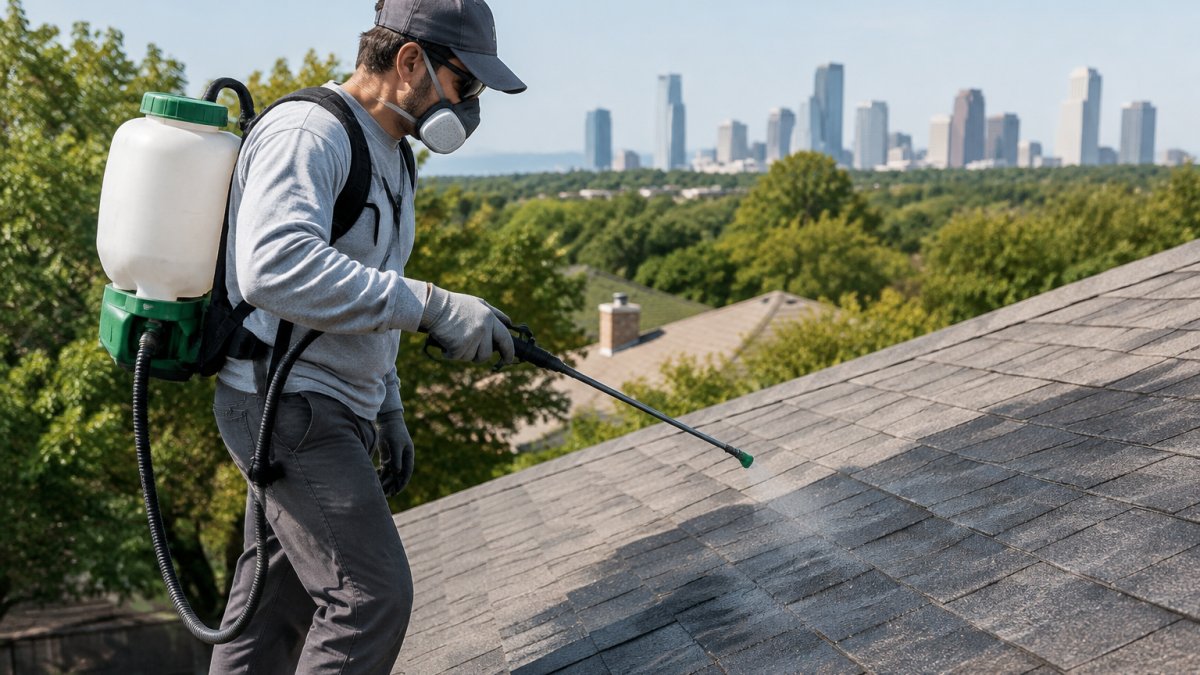
Application is where most exposure happens. Before you spray, cover or wet down nearby plants, move pet bowls and toys, and keep children and animals indoors. Wear eye protection and gloves, and avoid spraying on windy days so the mist does not drift.
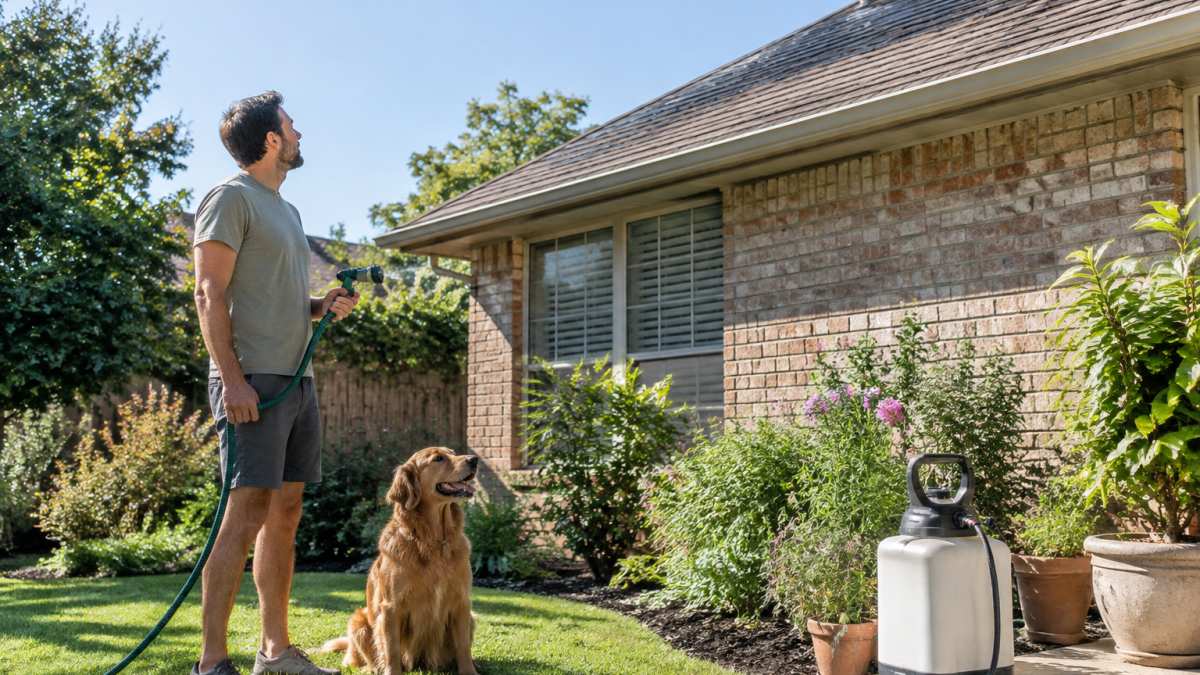
Water your lawn and plants after application to dilute any residue. Keep pets away from the runoff zone until the area has dried and been rinsed. If a spill reaches the ground, rinse it promptly with plenty of water.
- Cover or soak nearby plants before spraying
- Keep pets and children indoors during application
- Wear gloves, goggles, and a mask rated for the product
- Do not spray in wind, heavy heat, or before rain
- Rinse any spill on the ground right away
Environmental Impact of Roof Runoff and How to Contain It
Runoff is the single largest environmental pathway for any roof spray, and it is also the one most homeowners can control.
Many municipalities operate under stormwater permits that restrict non-stormwater discharges to storm drains (the EPA). Check with your local stormwater program for the rules that apply.
Containment starts before application, not after. Here is a practical sequence:
- Check the forecast. Do not apply any roof spray if rain is expected within the product's recommended cure or dry time (often 24-48 hours; check the label). Rain during or shortly after application dramatically increases runoff.
- Map your downspouts. Identify where each downspout discharges. If it empties onto a paved surface, into a storm drain, or into a rainwater tank, you need to redirect or block it before spraying.
- Block or redirect downspouts. Disconnect downspouts from storm drains and direct them onto a grassy or gravel area where soil and vegetation can filter and break down residues. If that is not possible, place a temporary cap or plug at the downspout outlet and use a portable pump or bucket to collect runoff during application and rinsing.
- Use a containment tarp or barrier. For roofs with heavy treatment or high runoff potential, place a tarp under the drip line to catch liquid. Slope the tarp toward a collection point (a bucket or sump) and dispose of collected liquid according to the product label and local hazardous waste rules.
- Protect rainwater collection systems. If you have a rain barrel or cistern, disconnect it or divert the first flush away from the tank. The first 10-20 gallons of runoff after application carry the highest concentration of residues. A first-flush diverter is a low-cost way to protect stored water.
- Rinse and dispose properly. After application, any rinse water from equipment or surfaces should be collected or directed to a vegetated area, not to a storm drain. Never hose residue into the street or gutter.
Watch out: A common mistake is to spray before a forecast rain 'to let the rain water it in.' For most roof sprays, rain immediately after application increases chemical runoff and reduces product performance. Follow the label's rain-fast timing.
If a spill or concentrated runoff reaches the ground, contain it with absorbent material (kitty litter, sand, or commercial absorbent) and dispose of it as directed by the product SDS and local waste regulations. Do not wash it into a storm drain.
These steps cost little and reduce the amount of product that leaves your property. Combined with choosing a product with readily biodegradable ingredients and low aquatic toxicity, containment is the most effective way to limit the environmental impact of any roof spray.
Choosing a Safe Treatment for Your Austin Roof
Start by asking any company what product they use and whether they will share the safety data sheet. Compare how each option handles runoff, plant safety, and pet safety. If you are weighing rejuvenation against replacement, check how the treatment might hold up in our hot climate. Our article Does Roof Rejuvenation Work in Hot Climates? explains what to expect from Austin summers.
Before you book, get a clear picture of your roof's condition. A free roof condition assessment in Austin shows whether a spray is appropriate at all, or whether your shingles have passed the point where treatment makes sense. You can also review our services to see how application is handled from start to finish.
If you want a more sustainable approach to roof care, our guide on eco-friendly roof shingle restoration covers non-replacement methods that reduce waste. Choose the option that protects your home, your yard, and your local water.
Ready to see what your roof needs? Get a free estimate from ATX Renewed Roofs and learn whether a plant-based rejuvenation treatment fits your home.
Frequently Asked Questions
Is roof spray safe for pets and plants?
Most roof sprays are safe for pets and plants once they have dried, but wet product can drift, pool on soil and be licked or walked through by animals. Keep pets and children indoors during application, cover garden beds and shrubs under the eaves, and rinse foliage with plain water after the job. Check the product's label and safety data sheet for specific re-entry times, and ask your contractor for the ingredient list before work begins.
Can roof spray runoff contaminate soil or waterways?
Runoff is the main environmental concern with any roof treatment. Rain that washes over a treated roof carries product into gutters, downspouts and storm drains, and from there into local waterways. Choose products with ingredients that break down readily, avoid application before forecast rain, and ask your contractor whether they use drop cloths, gutter protection or catch systems to limit runoff reaching lawns and drains.
Are biodegradable roof sprays safe for the environment?
Biodegradable does not automatically mean harmless. A product can break down over time yet still be toxic to aquatic life at high concentrations or while it is still active on the roof. Look for a full ingredient list, a safety data sheet and clear application instructions rather than relying on marketing claims alone. Plant-based formulations generally carry lower environmental risk than bleach-based products, but application practices still matter.
What is the difference between a roof cleaning spray and a roof rejuvenation spray?
A cleaning spray removes moss, algae, mildew and dirt from the roof surface, often using stronger biocides or bleach. A rejuvenation spray is designed to restore flexibility and surface protection to aging asphalt shingles, typically using plant-based oils. Many contractors use both in sequence, so ask which product is being applied, what it contains and whether the job includes cleaning, treatment or both.